
Technology
Why Did the Semiconductor Shortage Occur? The Reality of the Semiconductor Shortage That Shook the World
Key Points of This Article
- Demand surge, geographic concentration, geopolitics—three crises collided
- New fabs take years to build—supply cannot chase sudden demand spikes
- Rapidus' IIM lays the foundation for Japan's resilient chip supply chain
The semiconductor shortage refers to a situation in which the supply of semiconductors—the core components of products such as smartphones, automobiles and industrial equipment—could not keep up with demand.
From 2020 onward, global supply chains were disrupted by the spread of COVID-19. At the same time, a surge in stay-at-home demand and heightened geopolitical risks stemming from U.S.–China tensions brought the global semiconductor shortage sharply into focus.
As a result, supply disruptions spread across industries, including automobile production stoppages in addition to shortages of home appliances and gaming consoles.
Manufacturers worldwide were forced to revise production plans.
Semiconductors have become essential infrastructure supporting modern society, including AI, communications, energy systems and data centers.
A disruption in supply is not merely a parts shortage but a structural issue affecting the competitiveness of entire economies.
For Japanese companies as well, long-term strategies—such as diversifying procurement risks and rebuilding domestic production capacity—have become critical challenges.

Why Semiconductors Are Essential to Modern Society
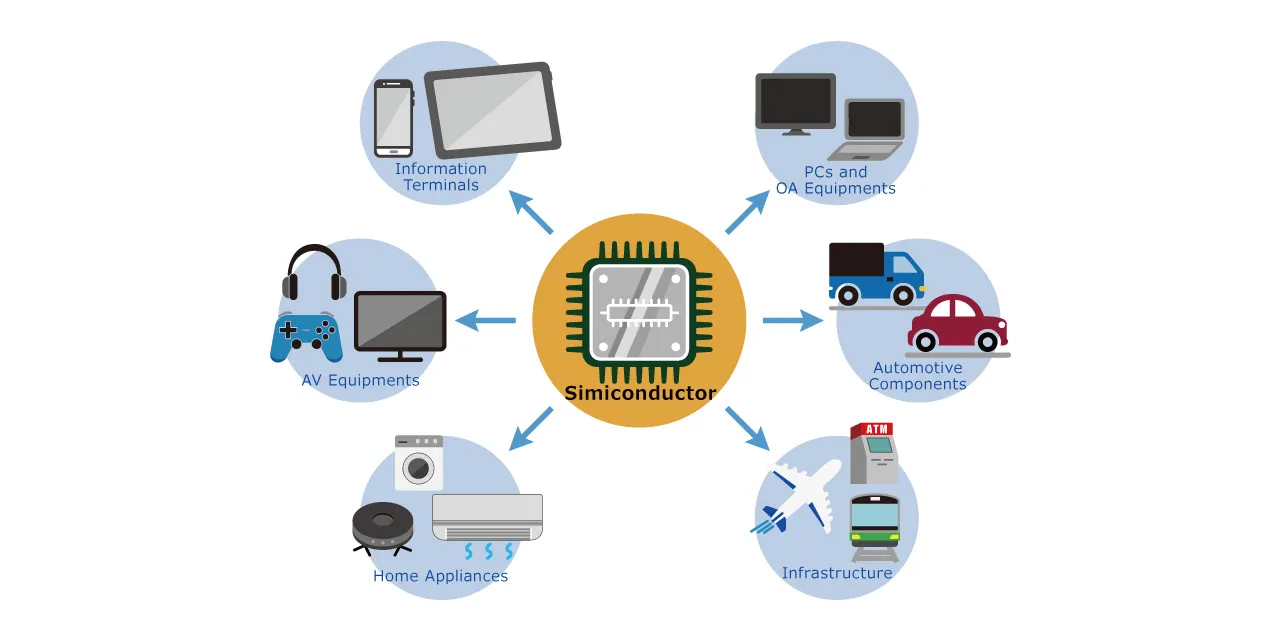
Semiconductors operate in nearly every aspect of society.
From smartphones, PCs, home appliances and automobiles to railway infrastructure, financial systems and factory production equipment, semiconductors are embedded in virtually all electronic devices.
Their stable operation underpins daily life and business activities.
Acting as the brains responsible for processing, storing and controlling information,
semiconductors form the foundation of next-generation infrastructure, including communication
networks, cloud servers, AI systems and energy management technologies. Without them,
communications, healthcare, finance and logistics could cease functioning, potentially
paralyzing economic activity.
In this sense, semiconductors are not merely components but
strategic resources that form the backbone of the digital economy.
Their importance rivals that of energy and natural resources, influencing national technology competition and industrial policy.
Because of their wide-ranging applications, the semiconductor industry is enormous in scale. In international trade, semiconductors rank among the largest product categories by trading value.
According to World Semiconductor Trade Statistics, the global semiconductor market reached approximately $630 billion in 2024, representing year-on-year growth of 19.7%. This reflects steadily rising demand driven by digitalization and network expansion.
Why Did Semiconductors Become Insufficient?
Unexpected Surge in Demand During the COVID-19 Pandemic
The COVID-19 pandemic led to widespread remote work and online learning, dramatically increasing demand for PCs, tablets and gaming consoles. Semiconductor demand, which had previously grown gradually, suddenly accelerated at a pace equivalent to pulling forward several years of growth.
In 2021, the global semiconductor market grew by 25.6% year-on-year to approximately $553 billion—its highest growth rate in 11 years—exceeding expectations due to robust digital demand.
The Automotive Industry's Miscalculation
The semiconductor shortage first became visible in the automotive sector. In the early stages of the pandemic, many automakers anticipated prolonged declines in vehicle demand and significantly reduced or canceled semiconductor orders.
However, demand rebounded more quickly than expected, and supply could not keep pace, resulting in production line stoppages and reduced output worldwide.
Semiconductor manufacturing requires lead times measured in months.
Major foundries allocate production capacity through annual contracts, limiting flexibility in responding to sudden demand fluctuations.
The automotive industry's reliance on just-in-time production methods also proved vulnerable. While efficient under stable conditions, minimizing inventory makes supply chains fragile during unexpected disruptions.
This episode highlighted the fragility of global supply chains, the difficulty of demand forecasting, and the structural rigidity of manufacturing systems.
Going forward, diversification and greater flexibility will be essential for maintaining competitiveness.
Structural Vulnerabilities in the Supply Chain
Semiconductor production is geographically concentrated, particularly in Taiwan and South Korea.
This concentration creates systemic risk.
Natural disasters—including droughts, cold waves, earthquakes and fires—along with equipment failures, have temporarily disrupted supply of critical materials and components.
Geopolitical tensions and export controls have further complicated stable procurement. In response to uncertainty, companies increased inventory levels, which in turn reduced available supply in the broader market and prolonged shortages.
The combination of geographic concentration, natural disaster risk, geopolitical instability and supply chain complexity significantly extended the duration of the semiconductor shortage. Strengthening supply chain resilience and diversifying production will be indispensable going forward.
Investment Barriers and Manufacturing Constraints
Building a new semiconductor fabrication plant requires enormous capital investment and significant time. Production capacity cannot be doubled instantly in response to demand spikes.
Advanced manufacturing equipment and materials are supplied by a limited number of specialized firms, further constraining expansion.
These structural constraints prevented supply systems from keeping pace with rapid global demand growth, resulting in prolonged shortages.
Impact on Daily Life and the Economy
The shortage affected both consumers and businesses.
Delivery times for new automobiles lengthened, and shortages and price increases occurred for gaming consoles, PC components and advanced home appliances.
Manufacturers faced production halts and output reductions due to insufficient chip supply. In 2021, major global automakers revised production plans downward, with millions of vehicles cut from output forecasts.
R&D activities were also delayed, when necessary, semiconductors were unavailable for prototyping, potentially affecting long-term competitiveness.
The shortage placed strain on employment, investment and overall economic performance. Governments worldwide responded with industrial support measures to strengthen domestic semiconductor capabilities.
Cutting-Edge Semiconductors Required in the AI Era
Despite these challenges, digital transformation continues.
AI adoption is driving explosive demand for data center computing power, pushing conventional semiconductor technology toward its limits.
Demand for advanced chips offering higher performance and improved energy efficiency is expected to grow further.
Rapidus will mass-produce 2nm-generation chips, which will support AI, high-speed communications and autonomous driving technologies.
By lowering transistor operating voltage through further miniaturization, 2nm technology significantly reduces power consumption—addressing operational cost and environmental challenges faced by AI data centers.
It also enhances computing performance for general-purpose ECUs used in autonomous and software-defined vehicles, enabling chip miniaturization and higher integration density.
Building an Advanced Manufacturing Base: IIM-1 in Chitose, Hokkaido
Rapidus is constructing its next-generation semiconductor manufacturing facility, IIM-1, in Chitose City, Hokkaido, incorporating environmentally harmonized advanced fab design.
Pilot line operations began in April 2025, and mass production is planned for 2027.
The facility introduced the first deployment of ASML's extreme ultraviolet lithography equipment for mass production in Japan, establishing a domestic base for advanced logic processes.

The RUMS Model: Integrated Manufacturing with Short Lead Times
Rapidus is also implementing a new production framework called Rapid and Unified Manufacturing Service or RUMS.
This model integrates design, front-end wafer fabrication and back-end packaging—areas traditionally fragmented—to deliver custom chips tailored to customer needs with industry-leading cycle times.
Through collaboration with IBM, Rapidus is advancing 2nm technology using gate-all-around transistors.
Seamless integration from design to mass production under the RUMS model will accelerate development and production ramp-up.
With IIM-1 at its core, Rapidus will expand collaboration with domestic and international partners to build a cutting-edge semiconductor ecosystem in Hokkaido, contributing to supply chain resilience and helping address semiconductor shortages.
- #AI_PC
- #NPU
- #edgeAI
- #lowPower
- #privacy
- #cloudFree
- #Rapidus
- #2nm


Recommendation