
Technology
What Are Semiconductors Used For? How They Work and Why They Underpin Modern Society
Key Points of This Article
- Invisible yet indispensable—semiconductors are the lifeblood of modern society
- Four chip types divide roles to power every electronic device
- As AI and IoT expand, chips become ever more critical strategic assets
At the core of countless electronic devices and systems that support our lives are semiconductors. They may look like simple black squares, but they function as electronic circuits, sensors and control units embedded across every field—from smartphones and home appliances to cars, communication networks, medical equipment, railways and power systems. In these domains, even minor malfunctions or supply delays can affect daily life and industry. Semiconductors are therefore not merely industrial products; they are the infrastructure of our modern society, supporting the flow of information, energy and transportation.
This article explains how semiconductors are used and why they are indispensable as infrastructure, with concrete examples.
Types of Semiconductors
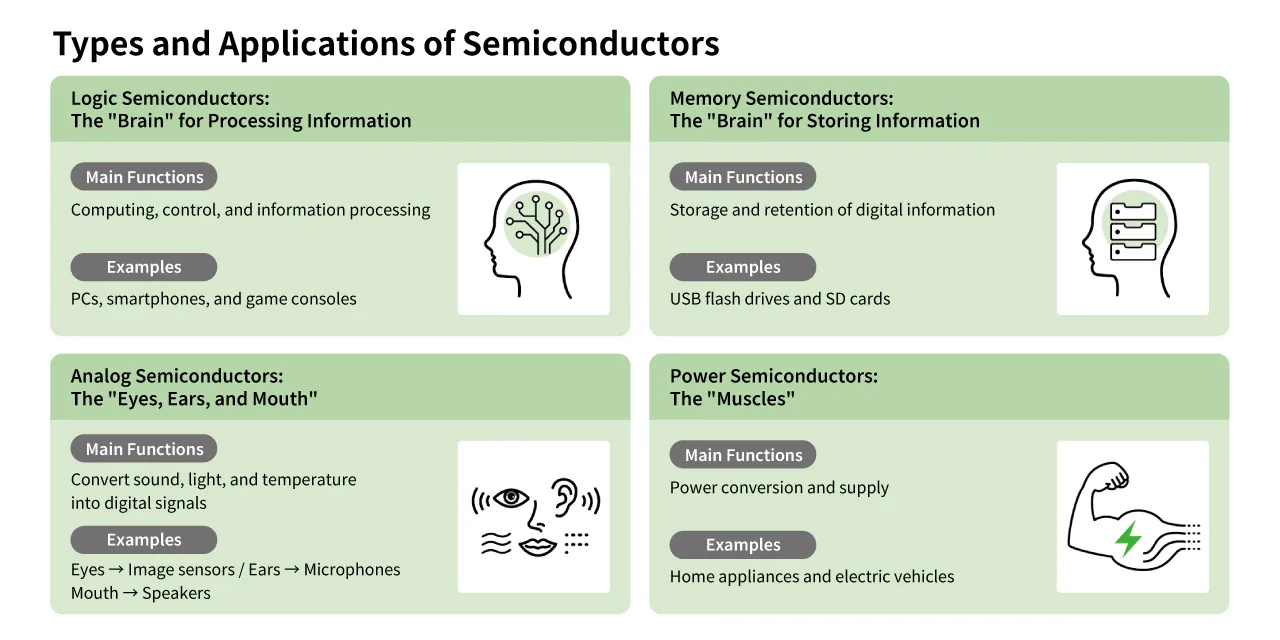
Logic Semiconductors
Logic semiconductors are the brain of electronic devices, performing computation and control. They include central processing units (CPUs) in computers, microcontrollers (MCUs) embedded in appliances and graphic processing units (GPUs) for image processing and AI workloads. They perform logical operations on inputs and output results or control signals to other components.
Example: In home appliances, MCUs process user inputs and sensor data to execute appropriate control actions.
Memory Semiconductors
These are responsible for storing and retaining data. They are broadly classified into volatile memory, like RAM, that holds data temporarily and non-volatile memory, such as ROM in the broad sense, including flash memory, that retains data when power is off. Memory semiconductors include DRAM in computers and smartphones, and NAND flash in SSDs. Memory devices enable both high-speed access and large-capacity storage.
Example: When taking photos on a smartphone, image data is buffered in DRAM and ultimately written to flash memory.
Analog Semiconductor Sensors
These detect real-world physical quantities—temperature, acceleration, light and sound—and convert them into electrical signals. They are the eyes and ears of digital devices. Smartphones contain many sensors including accelerometer, gyroscope, ambient light and image. Sensor outputs are digitized by an analog-to-digital converter (ADC) and processed by logic chips.
Power Control Semiconductors
Power devices control current and voltage for conversion and switching, enabling efficient energy control. Typical devices include power MOSFETs and IGBTs, which reduce power loss and heat by rapidly switching currents. Broader examples include power management ICs, regulators, DC-DC converters, motor drivers and LED drivers.
Example: In smartphones, a PMIC converts battery power to the various voltages required by each circuit and supplies them stably.
A Convenient, Prosperous Society Enabled by Semiconductors
Smartphones
Modern smartphones contain dozens to hundreds of semiconductor devices. At the heart is a high-performance logic chip called a System-on-a-Chip (SoC), which coordinates with sensors and memory to handle camera, communications and apps at high speed.
Photo capture workflow: When the shutter is tapped, the SoC instructs the camera module. The image sensor converts captured light into electrical signals, which are digitized and processed (correction/compression) by the SoC's image engine. Intermediate data is buffered in high-speed DRAM, and the final image is stored in flash memory. Meanwhile, power consumption during capture and general use is managed by power ICs, delivering just the required energy to each circuit for efficient, stable operation. Through this tight collaboration among chips, consumers enjoy smooth experiences from photography to gaming and AI assistants.

Home Appliances: Intelligent Household Helpers
Semiconductors are indispensable at home. Appliances like refrigerators and washing machines embed MCUs as control brains. Signals from temperature and water-level sensors feed into the MCU, which controls compressor on/off, heater output and water intake/drain based on built-in programs.
Examples:
- Refrigerator: Temperature sensors detect changes; the MCU finely tunes cooling for proper preservation and energy savings.
- Washing machine: A water-level sensor measures volume per load; the MCU controls valves for minimal water use, optimizes detergent dissolution via temperature sensing and varies motor speed with inverter control for precise drum movement.
Today, MCUs are built into microwave ovens, rice cookers and air conditioners, coordinating with sensors to smartly control operation. With continued semiconductor advances, appliances have evolved into smart appliances offering even greater convenience.
Cars: High-Tech Machines Delivering Safety and Comfort
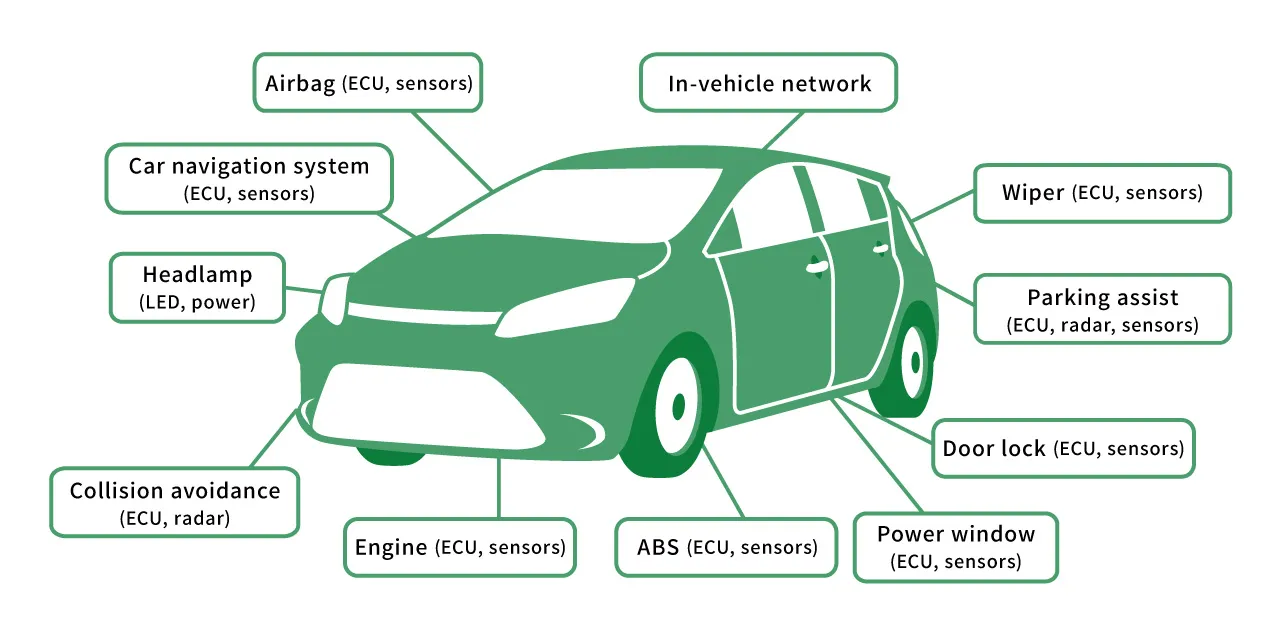
Modern cars are moving electronic devices, some including 100+ semiconductors. Key functions—engine, brakes, steering, airbags and power windows—are controlled by dedicated ECUs networked within the vehicle.
Examples:
- Engine ECU: Optimizes fuel injection and ignition timing from pedal position and RPM, improving both efficiency and power.
- Brakes (ABS): Wheel-speed sensors feed signals used to electronically control ABS, boosting safety during hard braking.
- Airbags: Acceleration sensors detect impact; the ECU instantly triggers deployment.
- Comfort features: Each power window includes a small MCU that controls the motor and detects overloads to prevent pinching.
- LED headlights: Light sensors and MCUs enable automatic high/low-beam switching. High-performance power semiconductors provide fast switching to modulate current for headlights and motors in real time.
With electronics pervasive throughout the vehicle, modern cars are safer, more comfortable and more efficient. As EVs and driver assistance systems advance, vehicles will incorporate even more semiconductors.
Traffic Signals, Vending Machines and Power Supply
Semiconductors also permeate public infrastructure.
- Traffic signals: Lamps are rapidly transitioning from bulbs to LEDs. Inside, MCUs manage timing and control. In some locations, sensors detect vehicles or pedestrian button presses to adapt signal patterns. Networks of signals can be coordinated to optimize traffic flow by time of day and load—again with semiconductors at the core.
- Vending machines: Embedded control systems integrate coin/bill acceptance sensors, product inventory sensors, motor-driven dispensing mechanisms and a central MCU coordinating all functions.
- Power supply: Power conversion and grid-control equipment use semiconductors to switch high voltage/high current safely and efficiently, optimizing consumption for stable, energy-saving supply. Without semiconductors, power delivery would be less efficient and less reliable.
Summary
As shown, semiconductors are the infrastructure backbone of modern society. Smartphones, home appliances, cars and countless other systems cannot function without them.
With the spread of IoT and AI and the use of big data, semiconductors play an ever-greater role. Realizing the future—smart cities connecting people, vehicles and infrastructure; smart homes where AI controls appliances and environments; and new services driven by autonomous vehicles and robots—will require even more capable semiconductor technologies.
The semiconductor industry continuously advances, pursuing both performance and energy efficiency through miniaturization and new materials. These steady innovations will give rise to new products and systems that dramatically transform our lives.
- #semiconductor
- #CPU
- #memory
- #powerSemiconductor
- #IoT
- #dataCenter
- #smartphone
- #Rapidus


Recommendation